
Revise

Transformers
Transformers
Transformers are essential to transform the current and voltage of the power supply to ones that are suitable for the device.
Transformers
A transformer consists of a soft iron core and two coils of wire. The coils are known as the primary coil and the secondary coil. The current enters the primary coil and causes a magnetic field to flow around the soft iron core. As the changing magnetic field reaches the secondary coil, an EMF is induced in the secondary coil.
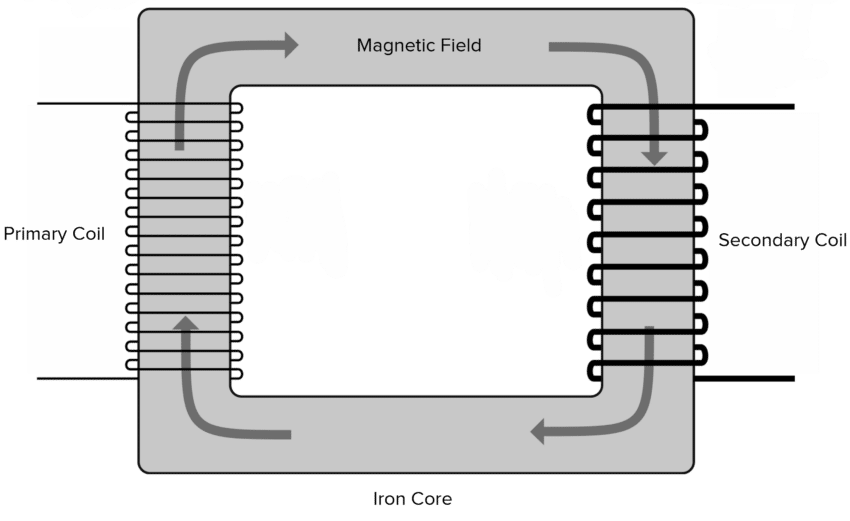
Although the transformer changes the voltage, the frequency of the alternating current is not affected by the transformer.
The transformer equation states:
- is the number of turns on the secondary coil.
- is the number of turns on the primary coil.
- is the voltage at the secondary coil in volts .
- is the voltage at the primary coil in volts .
Example: A transformer changes a power supply to output. If the primary coil has turns, how many turns are on the secondary coil?
[2 marks]
A transformer may either be a step-up or step-down transformer. A step-up transformer increases the voltage and a step-down transformer decreases the voltage supply.
The most common use of a step-up transformer is to increase the voltage (decrease the current) of a power supply for efficient transport in transmission cables. It always has more turns on the secondary coil than the first.
A step-down transformer reduces the voltage to a level that is safe enough to use in a device or certain area. They always have more turns on the primary coil than the secondary.

AQA A Level Physics Predicted Papers 2026/27
Our A Level Physics Predicted Papers are produced to the same high standard as real examination papers. Every question is written and reviewed by Physics subject specialists to ensure the level of challenge, format and structure closely reflect genuine A Level Physics exams. Each pack includes professionally printed exam papers and physical mark schemes, providing students with a realistic exam-style experience that goes beyond PDFs or generic revision materials. Checkout below and receive exclusive predicted papers available only from MME.
View Product
Efficiency
As with almost all devices, transformers are not efficient. Therefore the power output is always slightly less than the power input. Efficiency is a measure of how much of the energy input is transformed to useful energy output.
The transformers efficiency can be calculated by the equation:
- is the voltage at the secondary coil in volts .
- is the voltage at the primary coil in volts .
- is the current of the secondary coil in amps .
- is the current of the primary coil in amps .
Inefficiencies in Transformers
Transformers are not always efficient. The majority of the energy loss in a transformer comes from the production of Eddy currents. When the magnetic field is induced in the iron core, a small EMF is also induced which acts opposite in direction to the change that caused it (Lenz’s law). The current flowing in the soft iron core causes energy to dissipate as heat.
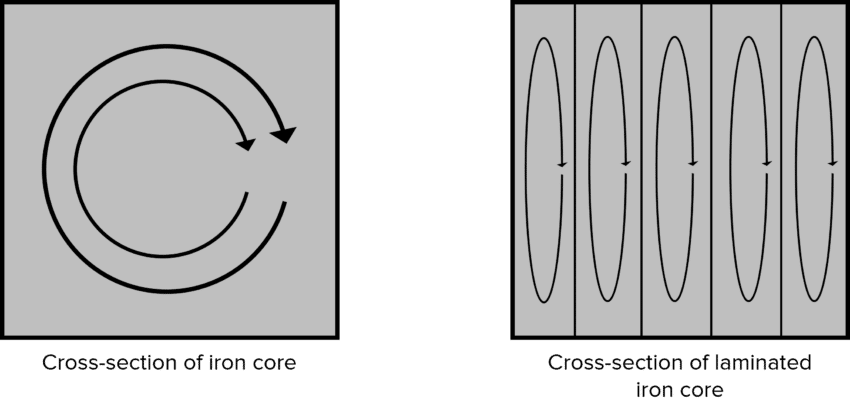
The Eddy currents can be reduced by laminating the iron core. This is where the iron core is sliced into smaller pieces with insulating materials wedged between the slices of iron. The higher the resistivity of metal also reduces eddy currents.
Transformers Example Questions
Question 1: Describe the role of the soft iron core in a transformer.
[1 mark]
To conduct magnetic fields between the primary coil and the secondary coil.


Question 2: Use the transformer equation to calculate the output voltage of a transformer when the input voltage is , number of turns on the primary coil is and the number of turns on the secondary coil is turns.
[2 marks]
Question 3: Describe the effect of eddy effects in a transformer.
[2 marks]
Eddy currents are hard to prevent. They form in the iron core and produce an electric current opposite the motion that caused them. They therefore increase power loss and decrease the efficiency of a transformer.
Specification Points Covered
AQA A Level:
- 3.7.5.6 The operation of a transformer (A-level only)
Transformers Worksheet and Example Questions

Transformers Questions
A LevelOfficial MME