
Revise

Standard Form
Standard Form
Standard form is a shorthand way of expressing VERY LARGE or VERY SMALL numbers. There are 6 key skills that you need to learn.
Standard from to ordinary numbers and ordinary numbers to standard form are two skills you will be taught.
Make sure you are happy with the following topics before continuing:

What is Standard Form?
We always write a number in standard form exactly like this:
The Three Key Rules
1) must be any between and , in other words, .
2) Standard form is always to the power of something ()
3) must be a whole number, this is the number of places the decimal point moves.
e.g.
Skill 1: Standard Form into Large Numbers
Example: Express as a number not in standard form.
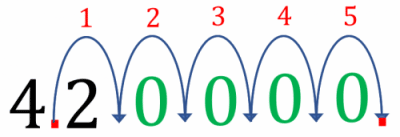
Firstly, recall that .
Then, we get
Multiplying by means moving the decimal place to the right, here we must do it times:
Step 1: Write out and move the decimal place jumps to the right.
Step 2: Add ‘s to fill in the spaces created as the decimal point has moved.
Step 3: Remove the original decimal point.
This gives the answer to be:
Skill 2: Standard Form into Small Numbers
Example: Write in decimal notation.
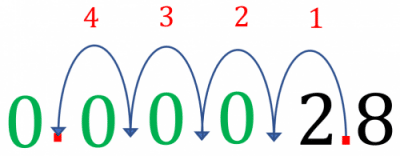
This is different because the power is negative, but it’s actually no harder. We know,
This means we are which means we move the decimal point spaces to the left.
Step 1: Write out and move the decimal place jumps to the left.
Step 2: Add ‘s to fill in the space created as the decimal point has moved.
Step 3: Remove the original decimal point.
Therefore, we have concluded that

Skill 3: Writing Large Numbers in Standard Form
Example: Write in standard form.
Step 1: Move the decimal point to the left until the number becomes
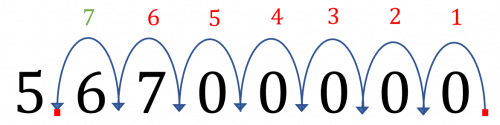
Step 2: Count the number of times the decimal point has moved to the left, this will become our power (), in this case .
Step 3: We have moved to the left meaning it will be not
So,
Skill 4: Writing Small Numbers in Standard Form
Example: Write in standard form.
Step 1: Move the decimal point to the right until the number becomes
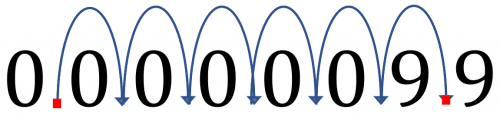
Step 2: Count the number of times the decimal point has moved to the right, this will become our power (), in this case .
Step 3: We have moved to the right meaning it will be not
So,
Skill 5: Multiplying Standard Form
Example: Find the standard form value of , without using a calculator.
Step 1: Change the order around of the things being multiplied.
Step 2: Multiply the numbers and the powers out separately.
Step 3: Convert the number at the front to standard form if necessary ().
This answer is not in standard form ( is not between and ), and we need it to be. Fortunately, if we recognise that , then we get that
Skill 6: Dividing Standard Form
Example: Find the standard form value of , without using a calculator.
Step 1: Break up the problem and change the order of how we divide things.
Step 2: Convert the number at the front to standard form if necessary ().
is between and , so this answer is in standard form, and so we are done.
(Remember: )
Standard Form Example Questions
Question 1: What is in decimal notation?
[1 mark]
The power is negative, so this is going to be a very small number. As the power of ten is , we want to divide the number by six times, and so we will move the decimal point six places to the left.
.


Question 2: What is in standard form?
[1 mark]
In this case, the power of is going to be positive.
So, if we move the decimal point in to the left six places it becomes . Therefore, we get that,
Question 3: What is in standard form?
[1 mark]
By considering the position where the first non-zero digit is compared to the units column we find,
as the is places away from the units column.
Question 4: Calculate
Give your answer in standard form.
[3 marks]
First, write each of the numbers in standard form i.e. and
Using the formula we can rewrite the eqaution as,
Standard form requires the number be between and , so adjusting by a factor of , we have,
Question 5: Calculate .
Give your answer in standard form.
[3 marks]
We will split up this multiplication, multiplying the initial numbers together and the powers of together separately. Firstly,
.
Secondly, using the multiplication law of indices,
So, we get
Standard form requires the number be between and , so adjusting by a factor of , we have,
Specification Points Covered
Number – 9. calculate with and interpret standard form , where and is an integer
Standard Form Worksheet and Example Questions

(NEW) Standard Form - Exam Style Questions - MME
Level 4-5GCSEKS3NewOfficial MMEStandard Form Drill Questions
Standard Form (1) - Drill Worksheet
Level 4-5GCSEKS3
Standard Form (2) - Drill Worksheet
Level 4-5GCSEKS3