
Revise

Direct and Inverse Proportion
Direct and Inverse Proportion
In maths, we say that two quantities are proportional if as one changes, the other changes in a specific way. There are two types of proportionality that you need to be familiar with, direct and inverse proportion. Make sure you are happy with the following topics before continuing.

Direct Proportionality – The Basics
If two quantities are directly proportional, then as one increases the other also increases at the same rate (proportionally), e.g. as one doubles, the other one also doubles.
Example: Jeremy uses of flour to make muffins. How much flour would he need to make muffins?
Step 1: Divide the amount of flour by to find the value of flour for muffin.
g of flour.
Step 2: Multiply the amount of flour needed for muffin by the muffins needed.
g of flour.
Inverse Proportionality – The Basics
If two quantities are inversely proportional, then as one increases the other decreases at the same rate (proportionally), e.g. as one doubles, the other one halves.
Example: builders can build houses in months. How long would it take builders to build the same number of houses?
Step 1: Multiply the number of months by the number of builders to get the time for builder.
houses would take builder months
Step 2: Divide the time it would take for builder by the builders.
houses would take builders months.

Direct Proportionality – with Algebra
If two quantities, and are directly proportional, we can write
This reads as ‘ is directly proportional to ‘, where ‘‘ is the proportionality symbol. We can turn it into an equation by replacing with :
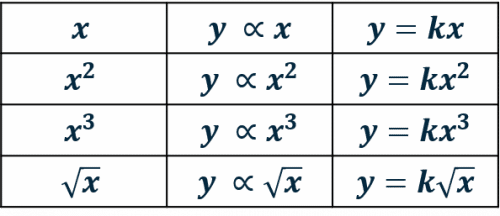
tells us how and are related, and is called the ‘constant of proportionality‘. Other examples of direct proportionality for can be seen in the table.
Inverse Proportionality – with Algebra
If two quantities, and are inversely proportional, we can write
This reads as ‘ is inversely proportional to ‘, where ‘‘ is the same proportionality symbol as before. We again turn this into an equation by replacing ‘‘ by ‘‘:
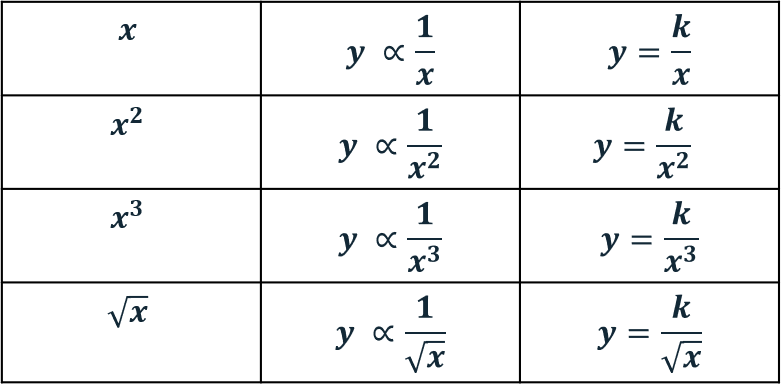
Other examples of inverse proportionality for can be seen in the table.
Proportionality graphs
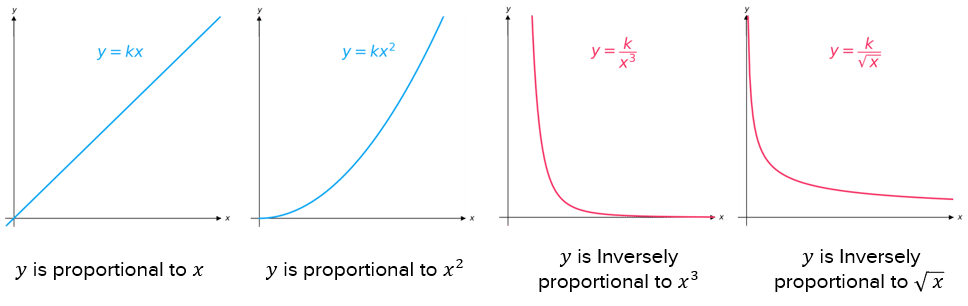
Once we convert the proportion into an equation, we can plot a graph easily.
Note: If you are a foundation student, you won’t explicitly be asked to form an equation. However, you will be expected to know how to work with constants of proportionality and use these equation, so all of this content is still important to you.
Example 1: Direct Proportion With Equation
The force acting upon an object can be modelled by the following equation:
a) The force on an object is increased from to . If the mass of the object stays the same, find the factor by which the acceleration changes.
b) The acceleration of an object is decreased from to . If the original force was , find the new force, and the mass of the object.
[5 marks]
a) Since the mass stays the same, the force is directly proportional to the acceleration.
The force increases by a factor of , so the acceleration must increase by a factor of also.
b) Again, force and acceleration are in direct proportion. The acceleration is decreased by a factor of , so the force must be decreased by the same factor.
The mass of the object can be found by substituting in the original values:
Hence,
Example 2: Inverse Proportion With Equation
The number of painters painting a house is inversely proportional to the time taken to complete it. Where number of painters is , and the time taken in hours is , and some constant ,
It takes painters hours to paint the house.
How long would it take painters?
[3 marks]
Firstly find the constant by substituting and into the equation
Now we have
So if
It will take painters hours to finish the house.
Example 3: Direct Proportion Setting Up Equation
is directly proportional to . When . Work out the value of when .
[3 marks]
Step 1: We have that is directly proportional to , i.e. . Then, expressing this as an equation we get
Step 2: In the question we’re given that when . Substituting these into the equation above, we get
Thus, the proportionality equation becomes,
Step 3: We can now use this to work out that when ,
Example 4: Inverse Proportion Setting Up Equation
is inversely proportional to . When . Work out the value of when .
[3 marks]
Step 1: We have that is inversely proportional to , so we write . Then, expressing this as an equation we get
Step 2: In the question we’re given that when . Substituting these into the equation above, we get
Thus, the proportionality equation becomes
Step 3: Therefore, when ,
Direct and Inverse Proportion Example Questions
Question 1: Katie is baking a cake. The recipe calls for the following:
of flour
of sugar
of butter
eggs
Katie uses of flour in her cake.
Find how much of the other ingredients she uses.
[3 marks]
First, find the scale factor:
Next, multiply the scale factor by the amounts of each ingredient.
Sugar:
Butter:
Eggs: eggs


Question 2: is directly proportional to .
when .
Find when
[2 marks]
Set up equation:
Substitute values to find :
Find using the new value of :
Question 3: is inversely proportional to the square of .
When . Calculate the value of when .
[3 marks]
is inversely proportional to the square of (i.e. ), so
We can rewrite this equation using to represent the constant of proportionality:
We know that when , so we can work out by substituting these known values into the equation:
Since we want to work out the value of , we need to rearrange the formula to make the subject which we can do by multiplying each side by :
We can now rewrite the original equation with a value for the constant :
Question 4: Given that is inversely proportional to , complete the following table.
[4 marks]

Since is inversely proportional to , we can write this as an equation, as follows:
We can rewrite this equation using to represent the constant of proportionality:
From the table, we know that when . If we substitute these values into our equation, we can work out the value of the constant .
Since
then
Since we want to work out the value of , we need to rearrange the formula to make the subject which we can do by multiplying each side by :
We can now rewrite the original equation with a value for the constant :
Now that we have calculated the value of the constant and rewritten the original proportionality equation, we can work out the value of when :
When
We can also work out the value of when :
When ,
If we multiply both sides by and divide both sides by , we have rearranged the equation making is the subject:
Therefore when
So, the completed table should look like this:

Question 5: The amount of money earned by Sasha, , is directly proportional to the number of hours she works, . If she works for hours she earns .
a) Express in terms of .
b) Using the equation formed in part a), or otherwise, find out how many hours it would take her to earn .
[4 marks]
a) Since is directly proportional to , we can write this as an equation, as follows:
We can rewrite this equation using to represent the constant of proportionality:
We know that when hours, so we can work out by substituting these known values into the equation:
Since we want to work out the value of , we need to rearrange the formula to make the subject which we can do by dividing each side by :
We can now rewrite the original equation with a value for the constant :
b) Now that we have calculated the value of the constant and rewritten the original proportionality equation, we can work out the value of when .
Since
then
If
then
So it will take Sasha hours to earn .
Question 6: is directly proportional to . When .
a) Write an equation connecting and
b) Calculate the value of when is
c) Calculate the value of when is
[6 marks]
a) is directly proportional to , so
We can therefore write this as an equation where is a constant:
We now need to work out the value of the constant which we can do by substituting in the known values for and :
Since
then
If we make the subject of the formula by dividing both sides by , we can work out the value of :
Therefore has a value of , which can be simplified to .
Now that we know the value of the constant , we can write the equation connecting and :
Since
then
or
b) We now have an equation connecting and , so we can work out the value of when is .
Since
then
So
c) We now have an equation connecting and , so we can work out the value of when is .
Since
then
So
Question 7: The time taken () for customers to receive their orders at a fast-food restaurant is inversely proportional to the square of the number of staff () on duty. It takes minutes for customer orders to be taken when there are staff members on duty.
a) Write an equation for in terms of
b) If the number of staff is doubled, how many times quicker will the customers receive their orders?
[4 marks]
a) Since the time taken () is inversely proportional to the square of the number of staff on duty (), we can write a basic equation as follows:
This formula can be rewritten using as a constant that connects and :
We can now work out the value of if we substitute in the known values for and :
Since
then
so
To work out the value of , we need to rearrange the formula, making the subject. We can do by multiplying both sides by :
So
Since we now know the exact value of , we can rewrite the proportionality formula:
Since
then
b) It would be too easy to assume that if you double the staff, then the time taken would be halved! Sadly, this is not the case.
If the number of staff is doubled, then there would be staff members on duty instead of . We know from part a) that and we know that . If we substitute these values into our formula, it should look like this:
Since
then
so
minutes
Therefore, if you double the number of staff the orders take minutes to be received instead of minutes, so the orders are received times faster.
Specification Points Covered
Ratio, proportion and rates of change – 6. express a multiplicative relationship between two quantities as a ratio or a fraction
Ratio, proportion and rates of change – 7. understand and use proportion as equality of ratios
Ratio, proportion and rates of change – 10. solve problems involving direct and inverse proportion, including graphical and algebraic representations
Ratio, proportion and rates of change – 13. understand that is inversely proportional to is equivalent to is proportional to ; construct and interpret equations that describe direct and inverse proportion
Ratio, proportion and rates of change – 14. interpret the gradient of a straight line graph as a rate of change; recognise and interpret graphs that illustrate direct and inverse proportion
Direct and Inverse Proportion Worksheet and Example Questions

(NEW) Direct and Inverse Proportion (Foundation) Exam Style Questions - MME
Level 4-5GCSENewOfficial MME
(NEW) Direct and Inverse Proportion (Higher) Exam Style Questions - MME
Level 6-7GCSENewOfficial MMEDirect and Inverse Proportion Drill Questions
Direct And Inverse Proportion
Level 6-7GCSE
Direct And Inverse Proportion 2
Level 6-7GCSE