
Revise

Set Notation
Set Notation
In maths, a set is a collection of things, usually numbers. Sets are often abbreviated as a capital letter. Venn diagrams and inequalities link in with sets so make sure you are happy with the following topics before continuing:

Understanding Set Notation
Sets are often denoted using the curly brackets { }, for example the set of the first odd numbers would be written with a capital such that, .
It is easier to visualise multiple sets by using Venn diagrams. If we were given another set then we can place the values of set in circle , and all the values of set in circle .
Any values that appear in both set and set should be placed in the intersection being careful not duplicate any values.
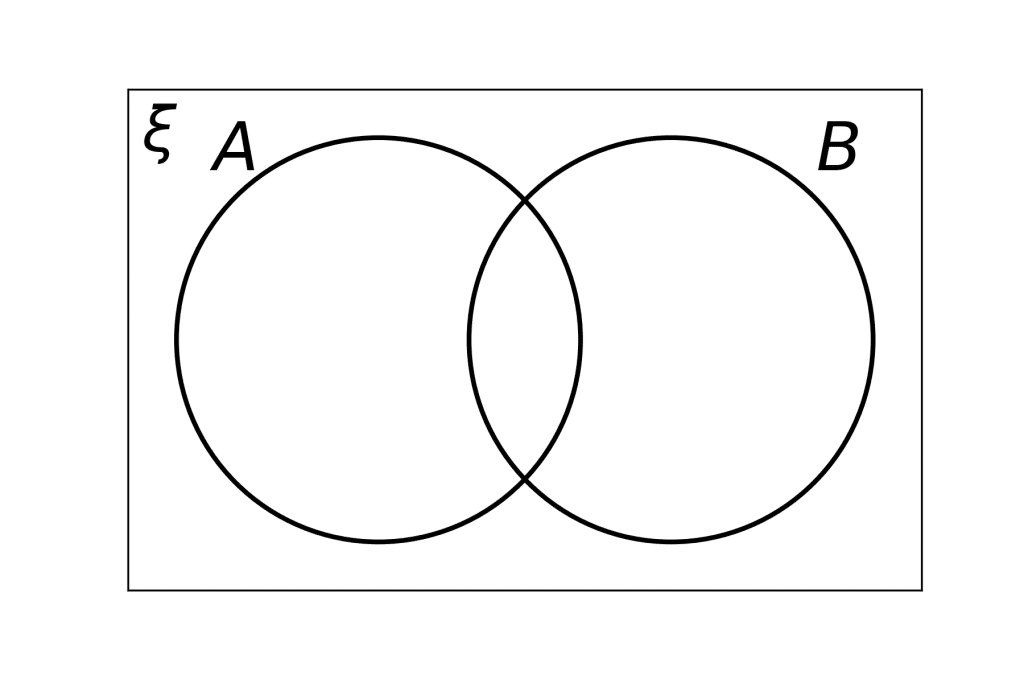
The Universal Set:
The universal set is everything inside the rectangle and is represented by the Greek letter “xi”, . It means all values that are to be included must be placed within the rectangle.
Note: If any numbers that are included but are neither within set nor set , they must go outside of the circles but inside the rectangle.
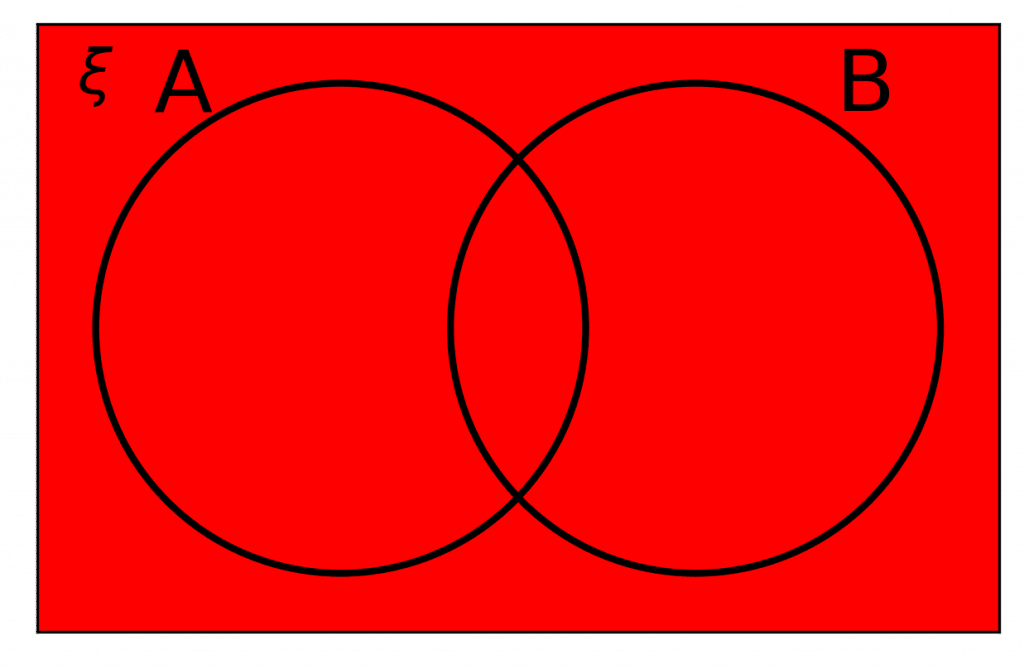
Notation Rule 1:
means everything that is contained only in .
Similarly if the question asked for everything inside it would be the entirety of that would need to be shaded.
refers to the number of elements within set . So if there were numbers inside circle , then
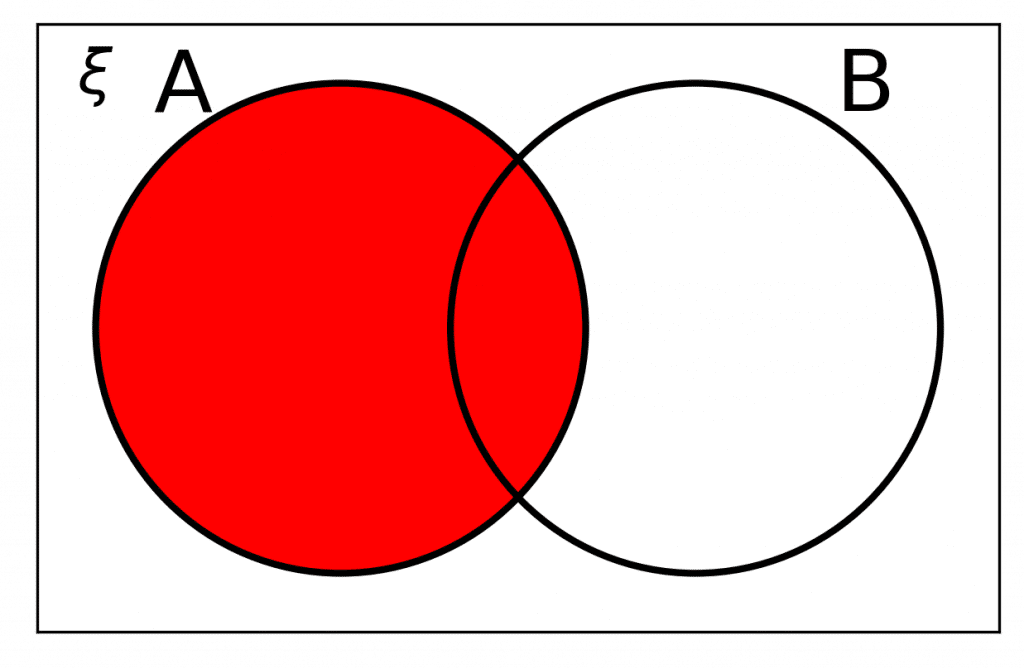

Notation Rule 2:
means not in .
It is a new set of all the elements from the universal set that do not appear in . Similarly for we can write to express elements that are not in .
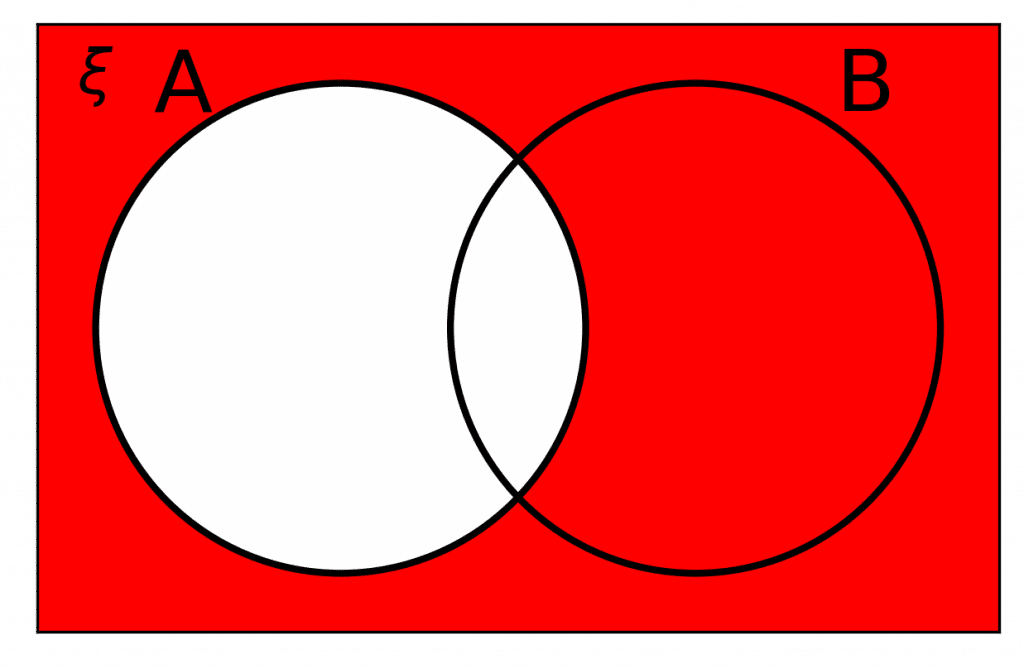
Notation Rule 3:
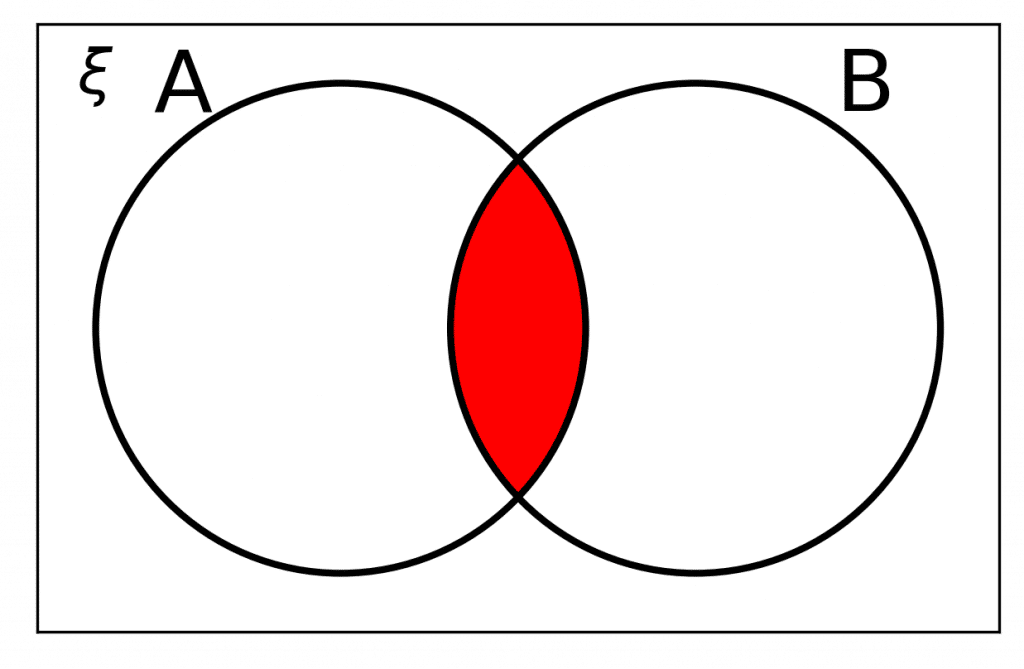
means and
|t is a new set that contains only elements that are in both and , i.e. the elements where and intersect.
Notation Rule 4:
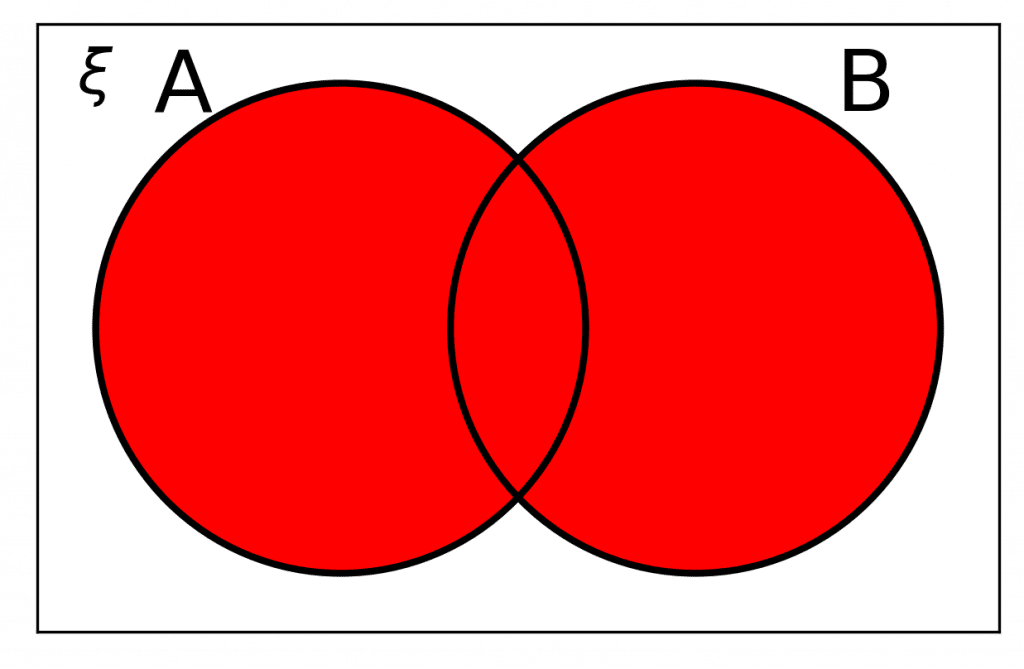
means or .
It is a new set that contains any elements that are in either or .
Notation Rule 5:
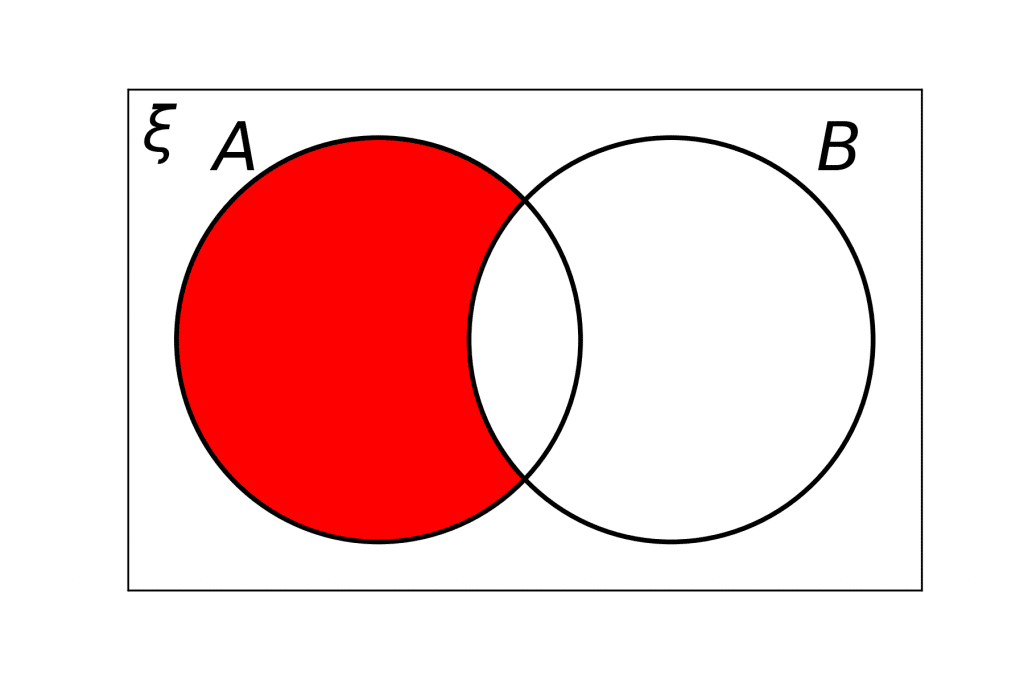
means and not .
It is a new set that contains any elements that are in but not in .
Set Notation for Inequalities
The other time set notation appears is when working with inequalities. The good news is, it’s pretty straightforward! To write the inequality in set notation, we write
So, you have to add things: curly brackets, the variable, and a colon.

Transition Maths Cards
The transition maths cards are a perfect way to cover the higher level topics from GCSE whilst being introduced to new A level maths topics to help you prepare for year 12. Your ideal guide to getting started with A level maths! The profit from every pack is reinvested into making free content on MME, which benefits millions of learners across the country.
View ProductExample 1: Set Notation
Let and . Write down the set
a)
b)
[2 marks]
a) contains every element that appears in both and .
Looking at the sets, we see that there are three of them: , , and . Therefore, we have
b) contains all the elements that are in either or . We have
Note: When a number appears in both sets, we don’t need to write it in twice.
Example 2: Sets Notation and Venn Diagrams
State which numbers are in the sets:
a)
b)
c)
[3 marks]
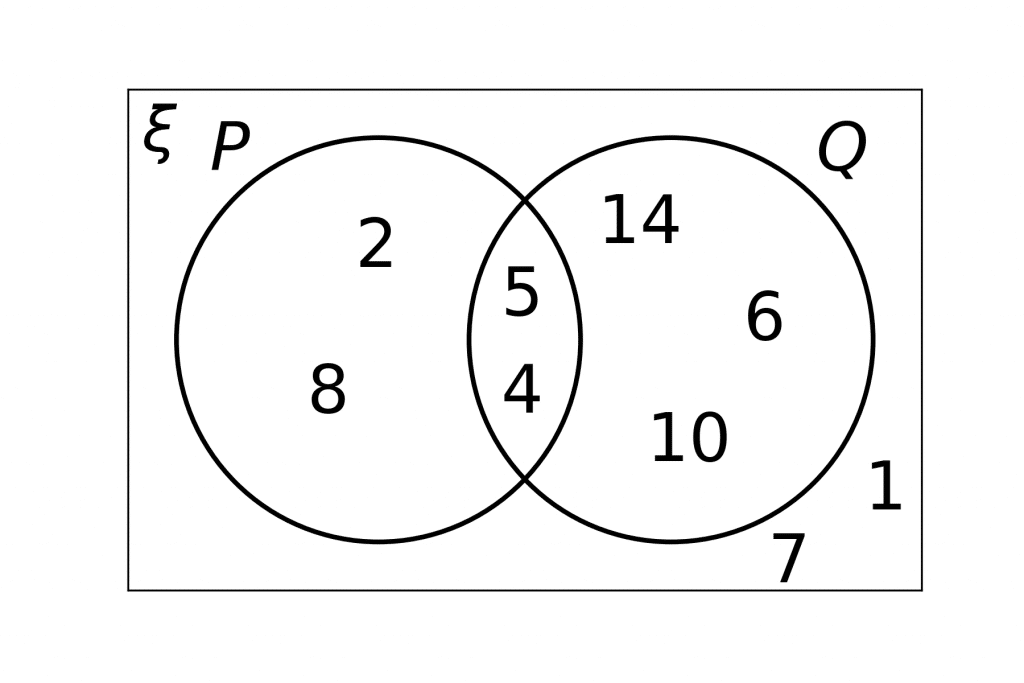
a) means all elements that are in both and . Looking at the Venn diagram, this must be where the circles intersect. So, we get
b) means all numbers not in . All the numbers inside the circle are: , , , , and (the ones in the intersection count). The numbers not in there are
c) means any numbers that appear in either or . So, anything in either circle. We get
Example 3: Sets and Inequalities
Solve the inequality . Write your answer using set notation.
[2 marks]
We solve linear inequalities like we do linear equations. Adding to both sides, we get
Then, dividing both sides by , we get
Now, to express this in set notation, we want to put “” before it and put the whole thing in curly brackets:
Set Notation Example Questions
Question 1:
from
State which numbers belong to the following:
a)
b)
[2 marks]
a) The first thing we need to do is work out which numbers belong to the subset . Since is the subset consisting of even numbers, then the following numbers belong in subset :
The symbol tells us that we need to combine subsets and , so when we combine the even numbers from subset with the numbers in subset , we have the following numbers:
(Note that you don’t write the numbers and twice.)
b) The dash after the means that we are interested in the set of numbers that are not in subset .
Since we already know that A is the subset of even numbers, is the group of odd numbers from the universal set :


Question 2:
in
Fill in the Venn diagram below to display this information.
[4 marks]
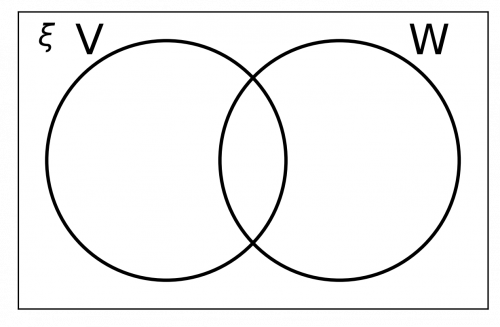
The first thing we need to do is work out which numbers from the universal set are in subset V, the set of prime numbers:
(Remember that a prime number is a number which is only divisible by itself and 1.)
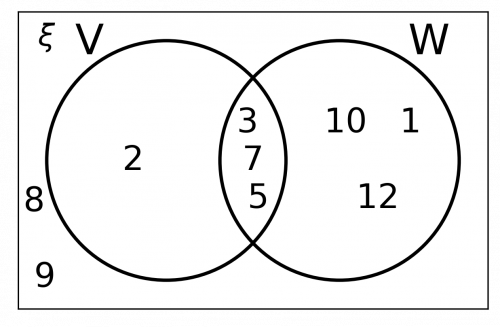
We are told in the question that . This means , and are in both circles. This means that these numbers must be placed in the small area where the two circles overlap.
This means that the only remaining number from the subset , the number , still needs to be placed. The number needs to be placed inside the circle, but outside the circle (in other words, not in the intersection).
Now that we have organised all the elements of subset , all the other numbers that are part of need to be placed inside , but outside (again, not in the intersection). These values that we need to be place here are the numbers , , and .
Finally, there are still some numbers in the universal set which have not yet been placed. All these numbers, the numbers and , need to placed outside the circles, but still inside the rectangle.
Your completed Venn diagram should be similar to the below:
Question 3: Write the following inequalities using set notation.
a)
b)
c)
d)
[4 marks]
The process for all questions will be the same. Write the variable followed by a colon before the inequality, and then put everything inside curly brackets { }. The results are as follows:
a)
b)
c)
d)
Question 4: Fill in the Venn diagram to show the following sets where = { : is an integer, }
= { : is a prime number}
= { : is a factor of }
= { : is a square number}
[5 marks]
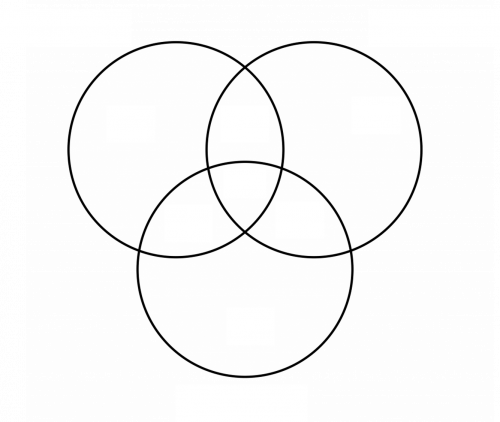
The question may appear a little bit off-putting due to the set notation. The key facts we need to understand are that:
- the universal set (all the numbers in the set) must be greater than (so from onwards), but less than (so up to and including ).
- all the numbers in set are prime numbers.
- all the numbers in set are factors of (numbers that can be divided by).
- all the numbers in set are square numbers.
It would probably be useful at this stage to write down which numbers fit into each set, and then see which numbers appear in multiple sets.
The prime numbers from are: . These are the numbers that will appear in set .
The factors of are: . These are the numbers that will appear in set .
The square numbers are: , and . These are the numbers that will appear in set . We can write these sets as:
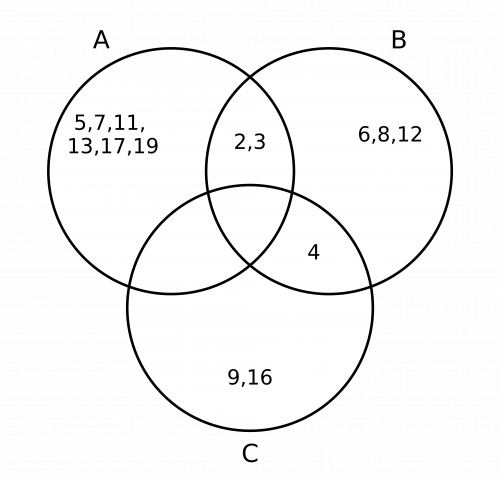
The first thing to check is to see if there are any numbers that belong to all three sets. There aren’t any, so the intersection of the three circles will be empty.
Having done this, look for any numbers that are common to sets. Sets and share numbers and , and sets and share the number . Therefore, we need to write and in the intersection of circle and circle , and the number in the intersection of circle and circle .
In set , we have already input numbers and on the Venn diagram, so we now need to input numbers . These numbers should be placed in the circle, but not in any of the intersections.
In set , we have already input numbers , and on the Venn diagram, so we now need to input numbers , and . These numbers should be placed in the circle, but not in any of the intersections.
In set , we have input the number on the Venn diagram, so we now need to input numbers and . These numbers should be placed in the circle, but not in any of the intersections.
The completed Venn diagram should look like the below:
Question 5: Shade the region that represents
[1 mark]
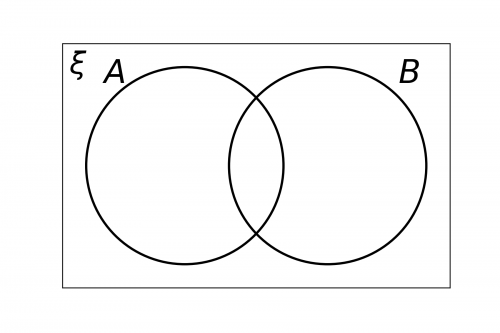
To work out the what area to shade, we need to be really clear on what means:
means everything ‘not in ‘.
means everything ‘not in ‘.
means ‘the intersection of’.
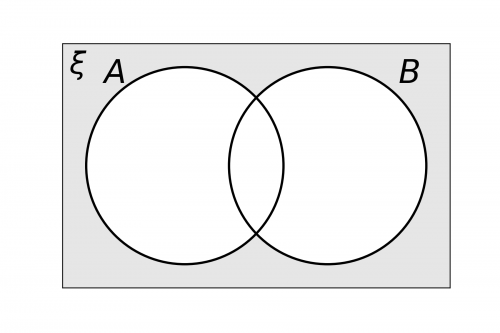 Therefore, we need to shade anything that is not in and which is also not in . Anything not in and not in is everything outside of the circles, so the Venn diagram should be shaded as follows:
Specification Points Covered
Algebra – 22. solve linear inequalities in one or two variable(s), and quadratic inequalities in one variable; represent the solution set on a number line, using set notation and on a graph
Probability – 4. apply the property that the probabilities of an exhaustive set of outcomes sum to one; apply the property that the probabilities of an exhaustive set of mutually exclusive events sum to one
Probability 6. enumerate sets and combinations of sets systematically, using tables, grids, Venn diagrams and tree diagrams
Set Notation Worksheet and Example Questions

(NEW) Set Notation Exam Style Questions - MME
Level 4-5GCSENewOfficial MME