
Revise

Long Division – The Bus Stop Method
Long Division
There are different methods that can be used for long division but the most commonly used in the UK is the Bus Stop method.

Bus Stop Method
This method for long division is called the Bus Stop method, since it looks like a bus stop. This method allows us to divide numbers to find integer answers or answers that have a remainder. There are a few steps that you need to follow.
Example: Calculate .
Step 1: We start by putting the division into the Bus Stop form as show below.

Step 2: We see how many times goes into , the first digit. The answer is so the is carried onto the next digit to make a new number, . The zero goes at the top.
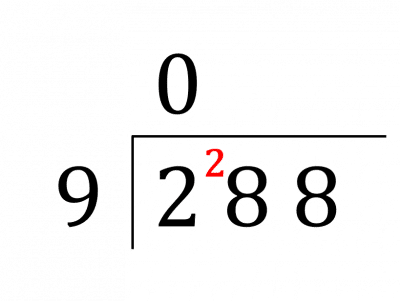
Step 3: Now, we see how many times goes into . We know that , so goes into times with a remainder , which is then carried in front of the next digit to make a new number, . The three goes at the top.
Step 4: Then, we see how many times the goes into , which is . The two then goes at the top. These two steps are combined in the image below.
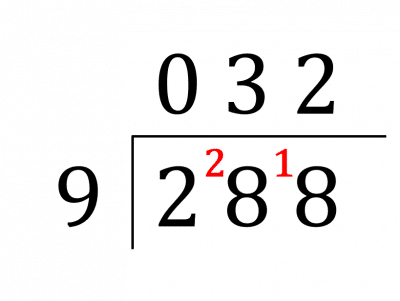
So,
Note: If did not go into the number in the last step, for example if the question asked to calculate , then goes into times, with a remainder . So we would say that the answer had a remainder of and we would write

Example: Long Division with a Remainder
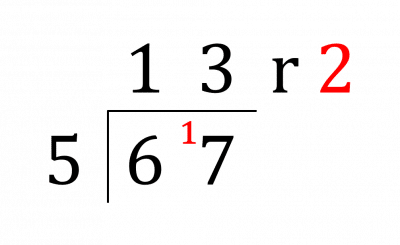
Calculate
[2 marks]
We use the same bus stop method as shown before, but this time we have a remainder.
Long Division – The Bus Stop Method Example Questions
Question 1: Work out .
[2 marks]
Here we’re going to use the bus stop method.
goes into zero times, so we write a zero above the line and a small – the remainder – in between the and the . Then, we see how many times goes into , writing the result above the line and the remainder just before the next digit of the dividend.
Repeat this process until you get the complete answer, which looks like,


Question 2: Calculate .
[2 marks]
Here we’re going to use the bus stop method,
goes into zero times, so we write a zero above the line and a small – the remainder – in between the and the . Then, we see how many times goes into , which is , writing the result above the line and the remainder, , just before the next digit of the dividend.
Repeat this process until you get the complete answer, which looks like,
Question 3: Calculate .
[2 marks]
Here we’re going to use the bus stop method,
goes into zero times, so we write a zero above the line and a small – the remainder – in between the and the . Then, we see how many times goes into , which is also zero, writing the result above the line and the remainder, , just before the next digit of the dividend.
Repeat this process until you get the complete answer, which looks like,
Question 4: Calculate .
[2 marks]
Here we’re going to use the bus stop method,
goes into zero times, so we write a zero above the line and a small – the remainder – in between the and the . Then, we see how many times goes into , which is , writing the result above the line and the remainder, , just before the next digit of the dividend.
Repeat this process until you get the complete answer, which looks like,
Question 5: Calculate .
[2 marks]
Here we’re going to use the bus stop method,
goes into zero times, so we write a zero above the line and a small – the remainder – in between the and the . Then, we see how many times goes into , which is , writing the result above the line and the remainder, , just before the next digit of the dividend, so we find,
Specification Points Covered
Number – 2. apply the four operations, including formal written methods, to integers, decimals and simple fractions (proper and improper), and mixed numbers – all both positive and negative; understand and use place value (e.g. when working with very large or very small numbers, and when calculating with decimals)
Long Division – The Bus Stop Method Worksheet and Example Questions

(NEW) Long Division Exam Style Questions - MME
Level 1-3GCSEKS3NewOfficial MME