Numerical Reasoning Test Examples
Work through numerical reasoning test examples with full guided solutions. Get comfortable with the format and content of numerical reasoning test questions with our worked examples below.
What Are Numerical Reasoning Tests?
A numerical reasoning test typically involves interpreting charts, tables, and written data to answer multiple-choice questions. You’ll need to apply maths skills like percentages, ratios, averages, and currency conversions. The aim is not just to get the answer right, but to do it quickly and under strict time conditions.
Practising with real numerical reasoning examples helps you get familiar with the format, reduce mistakes, and improve your overall speed.

Why Use Numerical Reasoning Example Questions?
Using numerical reasoning test example questions allows you to:
- Understand how questions are structured
- Build accuracy and confidence
- Develop time management techniques
- Identify common traps or confusing formats
This kind of practice is useful for anyone preparing for online assessments or employer selection processes. It’s also a helpful tool if you’re following a numerical reasoning course or using targeted numerical reasoning test practice materials.

Numerical Reasoning Test Examples
Question 1
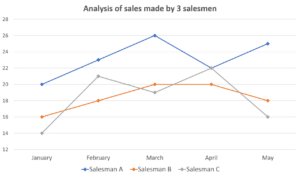
To the nearest percentage, what was the mean percentage increase in sales from January – February for the three salesmen?
Solution
Step 1: Salesman A’s percentage increase
Salesman A made 20 sales in Jan and 23 in Feb.
As a percentage increase, this can be calculated as follows:
Step 2: Salesman B’s percentage increase
Salesman B made 16 sales in Jan and 18 in Feb.
As a percentage increase, this can be calculated as follows:
Step 3: Salesman C’s percentage increase
Salesman C made 14 sales in Jan and 21 in Feb.
As a percentage increase, this can be calculated as follows:
Step 4: Calculate the mean
\dfrac{50 + 12.5 + 15}{3} = 25.83\% or \mathbf{26\%} to the nearest percentage
Question 2

What is the ratio of Pensions spending in 2006 compared to 2016?
Solution
Step 1: Calculate 2006 pension spend
18\% of \pounds491.8\text{ billion} = 0.18 \times 491.8 = \pounds88.524\text{ billion}
Step 2: Calculate 2016 pension spend
26\% of \pounds606.6\text{ billion} = 0.26 \times 606.6 = \pounds157.716\text{ billion}
Step 3: Construct the ratio and simplify
2006 : 2016 = 88.524 : 157.716 (we can ignore the billions)
To simplify, divide through by the lower value of 88.524 to give:
\mathbf{1 : 1.78} (2dp)
Question 3
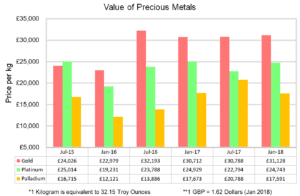
What is the total cost of Platinum, if \mathbf{1\bf{ kg}}, \mathbf{1\bf{ t.o}} (troy ounce) and \mathbf{1\bf{ pwt}} (pennyweight) are bought in July 2015? \mathbf{20\bf{ pwt} = 1\bf{ t.o}}. Answer to nearest pound.
Solution
Step 1: Find cost of 1\text{ kg} in Jul 2015
We can read the price directly from the chart: 1\text{ kg} = \pounds25,014
Step 2: Calculate the cost of 1\text{ t.o} in Jul 2015
We’re told that 1\text{ kg} = 32.15\text{ t.o}
So we need to divide the price of a kilo by 32.15
25,014 \div 32.15 = \pounds778.04
Step 3: Calculate the cost of 1\text{ pwt} in Jul 2015
We’re told that 1\text{ t.o} = 20\text{ pwt}
So we need to divide the price of a troy ounce by 20
778.04 \div 20 = \pounds38.90
Step 4: Add up the total cost
25,014 + 778.04 + 38.90 = \pounds25,830.94 = £\mathbf{24,831} to the nearest pound
Question 4
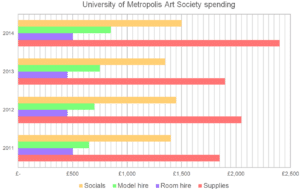
In 2013, the Art Society had \mathbf{186} members. In 2014, they increased the 2013 spend on supplies and socials by an amount equal to \mathbf{20\%} of money from membership fees that year. If annual membership costs £\mathbf{13}, how many members did the society gain that year?
Solution
Step 1: Find combined social and supplies cost for 2013 and 2014
2013 spend: 1,900 + 1,350 = \pounds3,250
2014 spend: 2,400 + 1,500 = \pounds3,900
Step 2: Calculate the difference in spend
\text{ Difference} = 3,900 - 3,250 = \pounds650
Step 3: Calculate the money generated from membership fees
We know the increase was 20\% of membership fees so the total fees in 2014 is
650 \div 0.20 = \pounds3,250
Step 4: Calculate the increase in members
A membership costs \pounds13 so there were 3,250 \div 13 = 250 memberships in 2014.
This is an increase of 250 - 186 = \mathbf{64} members.
Numerical Reasoning Test Examples FAQs
Why should I use numerical reasoning test examples when revising?
Working through numerical reasoning test examples helps you understand the types of questions you’ll face in real assessments. It also allows you to practise applying maths skills like percentages and ratios in a time-pressured setting.
Where can I find more numerical reasoning example questions?
You can explore additional numerical reasoning example questions on the numerical reasoning test practice page, which includes a wider range of realistic test-style questions.
What are common topics in numerical reasoning examples?
Most numerical reasoning test examples cover topics such as interpreting graphs, calculating averages, understanding ratios, and converting currencies. You can revise these topics using the numerical reasoning test revision guide, which breaks down each area clearly.
Do numerical reasoning examples follow the real test format?
Yes. The best numerical reasoning examples are designed to mirror real test conditions, with multiple-choice formats, realistic question wording, and time limits. This helps prepare you for the pressure of an actual assessment.
Can I get a free set of numerical reasoning example questions?
Absolutely. Try a free numerical reasoning test to access a full set of questions, along with instant feedback and explanations to help you learn from your results.
What’s the best way to learn from numerical reasoning examples?
Don’t just check the answers, take time to understand why each one is right or wrong. Use your practice results to shape your revision and revisit weak areas using a numerical reasoning course if you want step-by-step support.