Numerical Reasoning Questions
Practising numerical reasoning questions is one of the most effective ways to improve your speed, accuracy, and confidence before a real test. These questions are designed to assess how well you understand data, apply maths skills, and solve problems under time pressure.
Whether you’re preparing for a job assessment, graduate scheme, or apprenticeship, building familiarity with numerical reasoning test practice questions can help you perform at your best.
What Are Numerical Reasoning Test Practice Questions?
Numerical reasoning test practice questions usually involve interpreting data from graphs, tables, and written scenarios. You’ll be expected to work with percentages, ratios, averages, and basic arithmetic. Questions are typically multiple choice and must be answered quickly, often within a minute.
Using numerical reasoning sample questions is a great way to identify areas that need improvement. It also helps you become more confident with different formats and question types.
Tips for Answering Numerical Reasoning Questions
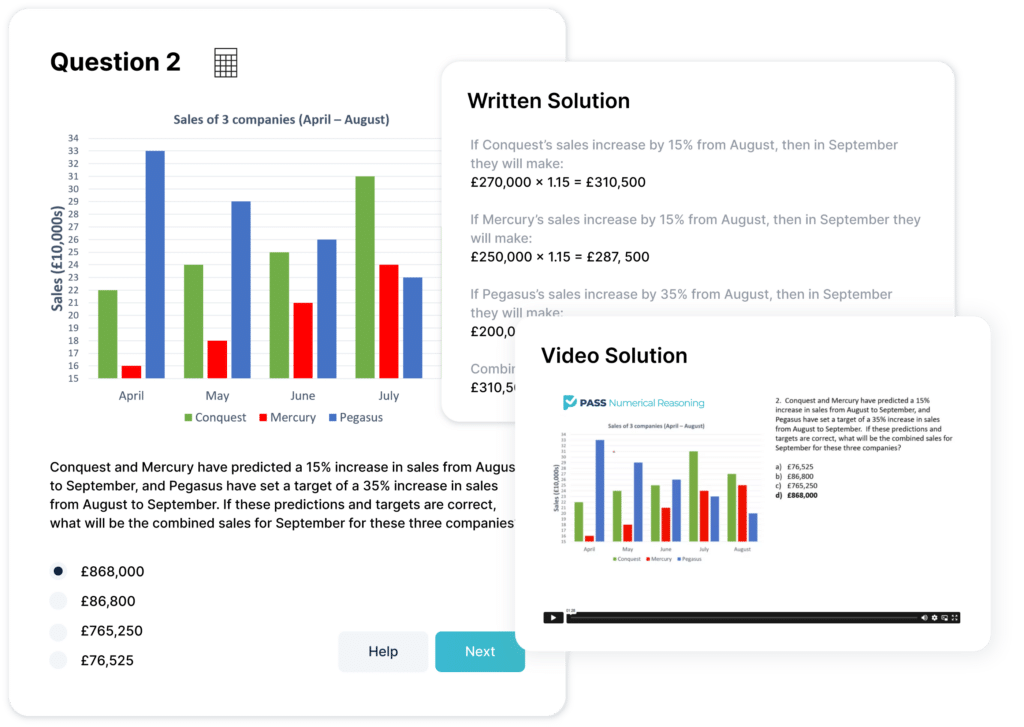
A lot of answering numerical reasoning test questions effectively is exam technique. Here are a few tips to keep in mind when sitting your test:
- Stay calm under time pressure
- Read carefully – small details can change the answer
- Eliminate wrong answers to narrow your choices
- Use estimation where appropriate to save time
- Review your mistakes after practice to improve
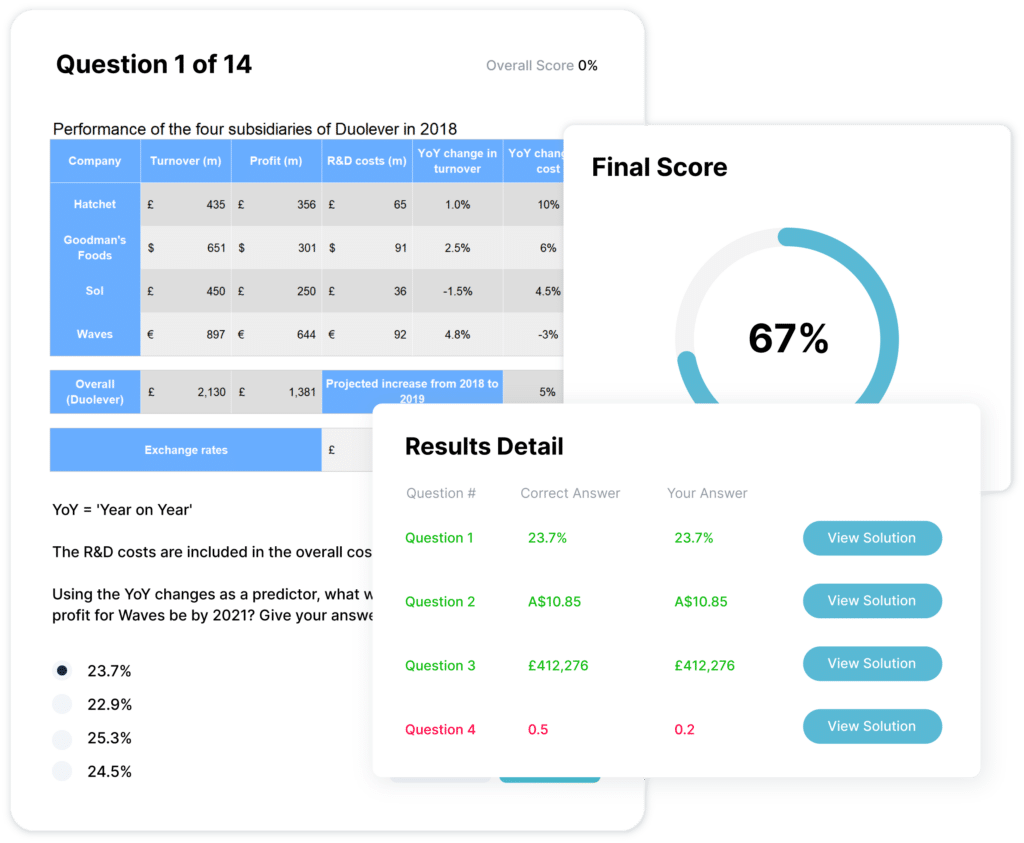
Completing numerical reasoning test practice questions is a sure fire way to get comfortable with the sorts of questions you will face on the day and how to answer them under time pressure.
Numerical Reasoning Test Practice Questions
Question 1
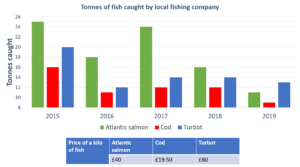
To the nearest whole number, what is the mean percentage decrease of the 3 fish types from 2015 to 2019?
- 39%
- 52%
- 23%
- 45%
Question 2
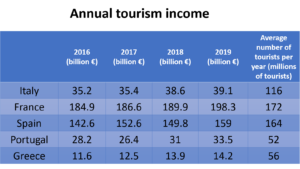
If 35% of the income from Spanish tourism is generated by tourists going to Barcelona, how much will Barcelona generate in 2020, to the nearest billion euros, if it is predicted that Spain’s total income from tourism will increase by 8% from 2019?
- €62 billion
- €60 billion
- €35 billion
- €46 billion
Question 3
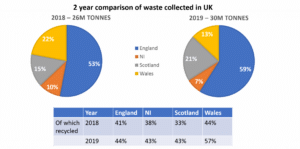
To the nearest hundred thousand tonnes, what was the difference between the number of tonnes of waste which was collected in England between 2018 and 2019?
- 39,000,000 tonnes
- 3,900,000 tonnes
- 480,000,000 tonnes
- 480,000 tonnes
Question 4
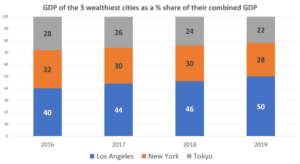
Express the combined GDP percentage of Los Angeles and New York in 2016 as a ratio compared to 2019.
- 1 : 1.083
- 1 : 1.623
- 1 : 1.102
- 1 : 1.78
Numerical Reasoning Test Practise Questions Solutions
Question 1 – Solution
Arctic salmon decreased from 25 to 11 tonnes. As a percentage decrease, this can be calculated as:
\dfrac{25-11}{25} \times 100 = 56\% decrease.
Cod decreased from 16 to 9 tonnes. As a percentage decrease, this can be calculated as:
\dfrac{16-9}{16} \times 100 = 43.75\% decrease.
Turbot decreased from 20 to 13 tonnes. As a percentage decrease, this can be calculated as:
\dfrac{20-13}{20} \times 100 = 35\% decrease.
The mean of these is therefore \dfrac{56 + 43.75 + 35}{3} = 44.92 = \mathbf{45\%} decrease to the nearest whole number.
Question 2 – Solution
If Spain’s 2020 income increase by 8\% from 2019, the amount they receive can be calculated as follows:
€159 billion \times 1.08 = €171.72 billion
If 35\% of this income comes from tourists in Barcelona, then this is relatively straightforward to calculate:
€171.72 \times 0.35 = €60.102 billion or €\mathbf{60} billion, to the nearest billion.
Question 3 – Solution
In 2018, England collected 53\% of 26 \text{ million} tonnes. This is equivalent to:
26\text{ million} \times 0.53 = 13.78\text{ million tonnes}In 2019, England collected 59\% of 30 \text{ million} tonnes. This is equivalent to:
30\text{ million} \times 0.59 = 17.7\text{ million tonnes}The difference is then 17.7\text{ million} - 13.78\text{ million} = 3.92 \text{ million tonnes}
3,920,000 = \mathbf{3,900,000} to the nearest hundred thousand.
Question 4 – Solution
Combined GDP of LA and New York in 2016 was 40 + 32 = 72
Combined GDP of LA and New York in 2019 was 50 + 28 = 78
This is a ratio of 72 : 78
We can then divide both by the lowest figure (72) to get \mathbf{1 : 1.083}
Numerical Reasoning Questions FAQs
What are numerical reasoning test practice questions?
Numerical reasoning test practice questions are designed to help you prepare for real assessments by simulating the types of problems you’ll face. They typically involve interpreting graphs, working with percentages, calculating ratios, and solving data-based scenarios under time pressure.
Where can I find more numerical reasoning practice questions?
You can find a wider range of numerical reasoning practice questions on the numerical reasoning test practice page, which includes question sets, mock tests, and tips to improve your speed and accuracy.
What topics do numerical reasoning questions usually cover?
Most numerical reasoning example questions focus on key maths skills like averages, percentages, ratios, and interpreting tables or charts. You can revise each topic in detail using the numerical reasoning test revision page.
Can I try numerical reasoning sample questions for free?
Yes, you can start by completing a free numerical reasoning test which includes timed questions and instant feedback. This is a great way to practise and review numerical reasoning sample questions in a realistic test format.
How should I approach numerical reasoning example questions?
Read the question carefully, scan for key data, and manage your time wisely. Practising regularly with numerical reasoning example questions helps improve accuracy and builds confidence when working under pressure.
Do numerical reasoning questions appear in job assessments?
Yes, many employers use these tests during the recruitment process for roles that require decision-making and analytical thinking. Practising numerical reasoning test practice questions in advance gives you the best chance of performing well on the day.